Periodontal Treatment Ventura: What Patients Need to Know

Most people think of dental care in terms of cavities, cleanings, and the occasional crown. Gum health often gets less attention until there is bleeding, bad breath, tenderness, or the unsettling moment when a tooth starts to feel a little loose. That is usually when periodontal disease stops being abstract and becomes personal.
If you are looking into periodontal treatment Ventura patients commonly need, it helps to understand one basic fact at the outset: periodontal disease is not just a cosmetic issue, and it rarely improves on its own. It is an infection and inflammatory condition that affects the gums, the bone that supports the teeth, and the attachment structures that keep teeth stable. Left untreated, it can move from mild irritation to irreversible damage.
The good news is that modern periodontal care is practical, often very manageable, and usually far less intimidating than patients expect. In many cases, treatment begins with conservative steps, not surgery. The real key is timing. The earlier gum disease is identified, the simpler the treatment tends to be and the better the long-term outlook.
What periodontal disease actually is
Healthy gums fit snugly around the teeth. They do not bleed easily, and they help form a tight seal that protects the deeper support structures under the gumline. Periodontal disease starts when bacterial plaque accumulates around the teeth and below the gums. If that plaque is not removed effectively, it hardens into calculus, often called tartar, which cannot be brushed away at home.
At the earliest stage, this leads to gingivitis. Gums may look puffy or red and may bleed when brushing or flossing. Gingivitis is common, and importantly, it is reversible with proper care. Once the condition progresses deeper and begins affecting the ligaments and bone that support the teeth, it becomes periodontitis. At that point, treatment can control the disease, but the lost bone and attachment do not simply grow back on their own.
This is one of the most important distinctions patients need to hear clearly. Bleeding gums are not normal, even if they have happened for years. A lot of adults assume bleeding during brushing means they should brush less in that area. Usually the opposite is true. Inflamed gums often bleed because bacterial buildup has been allowed to sit undisturbed.
Why Ventura patients often wait too long
In a coastal community like Ventura, many patients lead active, busy lives and tend to delay care until symptoms interfere with comfort or appearance. Gum disease encourages that delay because it can progress quietly. Cavities often hurt. Periodontal disease often does not, at least not early.
A common scenario in practice is the patient who says, “My gums bleed a little, but they’ve always done that.” Another is the patient who comes in concerned about a front tooth shifting or spaces appearing between teeth that were not there a few years ago. By the time movement becomes visible, the supporting structures may already be significantly compromised.
There are also practical barriers. Some people worry that periodontal treatment will be extremely painful or expensive. Others assume losing teeth is just part of aging. Neither assumption is accurate. Tooth loss is often preventable, and many periodontal therapies are straightforward when disease is caught at an earlier stage.
The signs that deserve attention
Some warning signs are obvious, while others are subtle enough to miss during everyday routines. If any of the following sound familiar, it is worth scheduling an evaluation rather than waiting for the next routine cleaning.
- Gums that bleed during brushing, flossing, or eating
- Persistent bad breath or a bad taste in the mouth
- Gum recession, or teeth that look longer than they used to
- Tender, swollen, or red gums
- Loose teeth, bite changes, or new spacing between teeth
One detail many patients overlook is gum recession. People often notice sensitivity to cold first, especially near the gumline, and assume it is only enamel wear. Sometimes that is part of it, but recession can also point to active periodontal issues, aggressive brushing, clenching, or a combination of factors. Good periodontal care involves sorting out which cause is actually driving the problem.
How gum disease is diagnosed
A proper periodontal evaluation is more detailed than a quick look at the gums. It usually includes measuring the depth of the pockets around each tooth. These pockets are the spaces between the tooth and the surrounding gum tissue. In healthy conditions, they are generally shallow. As periodontal disease progresses, those measurements increase because the gum attachment and underlying bone support are being lost.
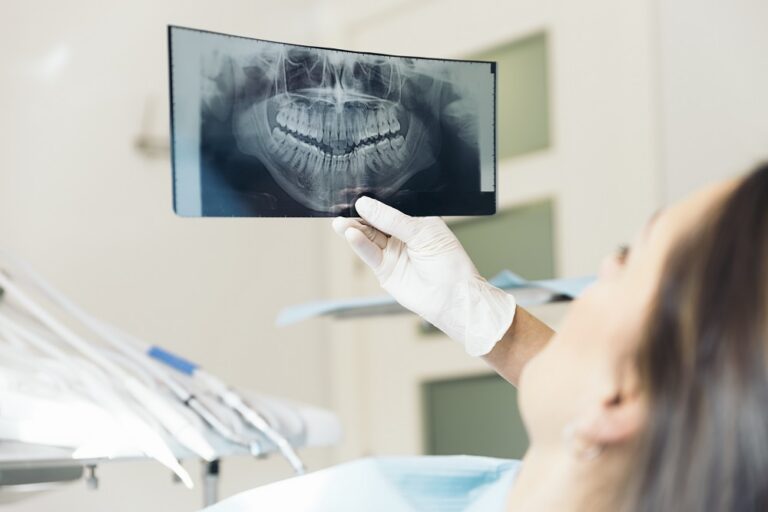
Dental X-rays are also important because they show bone levels that cannot be judged accurately by sight alone. A patient can have pockets, inflammation, and bone loss with relatively little pain. That is why a periodontal charting appointment may feel more involved than a standard recall visit. The extra information matters.
Dentists and periodontists also look at bleeding points, areas of recession, mobility, bite stress, plaque accumulation, and the shape of existing restorations. A crown margin that traps plaque, a bridge that is hard to clean under, or crowded lower front teeth can all affect how disease behaves and how treatment should be planned.
This is where individualized judgment matters. Two patients can have “gum disease” and need very different care. One may need only improved home care and a more targeted cleaning schedule. Another may need deep cleaning, bite adjustment, localized antimicrobial therapy, or surgery to reduce pocket depths and access areas that cannot be maintained otherwise.
The difference between a routine cleaning and periodontal treatment
This point causes a lot of confusion. A regular dental cleaning is designed to remove plaque and tartar from tooth surfaces in a mouth that is otherwise periodontally stable, or close to it. Periodontal treatment is different. It addresses disease below the gumline and focuses on stopping infection and preserving support structures.
When a patient with active periodontal disease is booked for “just a cleaning,” it usually does not solve the underlying problem. That is not upselling. It is simply the reality that infected pockets and hardened deposits under the gums require a different kind of care.
One of the most common non-surgical treatments is scaling and root planing, often called a deep cleaning. This procedure removes plaque and tartar from below the gumline and smooths root surfaces so the gums have a better chance of healing and reattaching more closely to the teeth. Depending on the extent of disease, it may be done over one or more visits and often with local anesthetic for comfort.
Patients sometimes feel uneasy when they hear the term “deep cleaning,” largely because it sounds more dramatic than it often is. In practice, many people tolerate it very well. The gums may feel tender for a few days, and temporary temperature sensitivity is possible, but the procedure itself is usually quite manageable.
What treatment may involve
The right plan depends on severity, anatomy, health history, and whether the patient can realistically maintain the result. That last factor matters more than people expect. There is little benefit in performing sophisticated periodontal therapy if the home care routine and follow-up schedule are not sustainable.
A periodontal treatment plan may include:
- Scaling and root planing to remove deposits under the gums
- Antimicrobial rinses or localized antibiotic therapy in selected sites
- More frequent periodontal maintenance visits, often every three to four months
- Surgical treatment for deep pockets, gum recession, or difficult access areas
- Replacement or modification of restorations that trap plaque or interfere with cleaning
Not every patient needs every item on that list. In fact, many do not. The aim is to stabilize disease as conservatively as possible while being honest about what the mouth needs.
Periodontal maintenance deserves special mention because patients sometimes mistake it for an optional add-on after treatment. It is not. Once someone has had periodontitis, they remain more vulnerable to recurrence. Maintenance visits are designed to monitor pocket depths, remove bacterial buildup before it becomes established again, and catch changes early. For many patients, three- or four-month intervals are appropriate, especially in the first phase after active treatment.
When surgery becomes part of the discussion
The word “surgery” can overshadow everything else, but periodontal surgery is not a single, one-size-fits-all event. It can mean several very different procedures, each with a specific purpose.
Pocket reduction surgery may be recommended when deep areas remain after non-surgical treatment and cannot be cleaned effectively by the patient or the hygienist. In those cases, lifting the gum tissue slightly can allow direct access to remove deposits and reduce the pocket depth. For a patient with persistent inflammation in isolated deep sites, this can be a practical way to make the area maintainable long term.
Gum grafting is another common periodontal procedure, especially in cases of recession. Patients often seek grafting because of sensitivity or appearance, but grafts can also help protect vulnerable root surfaces and reduce further recession in selected cases. Not every recessed area needs a graft. A stable, shallow recession in a patient with excellent hygiene and no sensitivity may simply be monitored. Again, context matters.
Bone grafting or regenerative procedures may be considered in certain defects where the shape of the bone loss makes regeneration more feasible. Outcomes vary depending on anatomy, smoking status, oral hygiene, and the severity of disease. Honest clinicians avoid promising that every lost millimeter of support can be rebuilt. Sometimes the goal is regeneration. Sometimes the more realistic goal is stability.
What patients usually feel during and after treatment
Fear of discomfort keeps many people from getting care. In day-to-day practice, the anticipation is often worse than the reality. Local anesthetic is routinely used for deeper cleaning and periodontal procedures when needed. Most patients report pressure and vibration more than sharp pain during treatment.
Afterward, soreness can range from minimal to moderate depending on what was done. Deep cleanings often lead to temporary tenderness and some sensitivity to cold. Surgical procedures may involve a few days of swelling or tenderness, but these are generally manageable with standard post-operative instructions, prescribed or recommended medications, and a softer diet for a short period.
One practical point that surprises patients is that the gums can look a little different once inflammation goes down. Puffy tissue shrinks as it becomes healthier, so spaces between teeth may appear more noticeable after treatment. That can feel alarming if no one has explained it in advance. It does not mean the treatment caused damage. It often means longstanding swelling is finally resolving, revealing the actual contours of the tissue.
Smoking, diabetes, stress, and other factors that change the picture
Gum disease never exists in a vacuum. The mouth reflects the rest of the body more than many patients realize.
Smoking is one of the strongest risk factors for periodontal destruction and poor healing. It also masks symptoms. Smokers sometimes bleed less than non-smokers because nicotine affects blood flow, so the gums may look less inflamed than the disease really is. That false calm can delay treatment.
Diabetes also changes the conversation. Poorly controlled blood sugar can worsen gum inflammation and impair healing, while active periodontal infection can make blood sugar harder to manage. The relationship runs both ways. Patients with diabetes often do very well with periodontal treatment, but they benefit from closer monitoring and coordination with their overall medical care.
Clenching and grinding do not cause periodontal disease by themselves, but they can worsen the effects by increasing stress on teeth that already have reduced support. A patient with moderate bone loss and heavy night grinding may experience mobility faster than someone with the same bone levels and a lighter bite.
Stress, dry mouth, medication side effects, and inconsistent home care also matter. None of these factors automatically doom treatment. They simply influence the plan and the expectations.
Home care that actually helps
Patients often ask whether there is a special toothpaste or mouthwash that can reverse gum disease. The short answer is no. Products can support treatment, but they do not replace mechanical plaque removal.
What matters most is consistent disruption of bacterial buildup at the gumline and between the teeth. That usually means brushing thoroughly twice a day with a soft-bristled brush and cleaning interproximally every day with floss, interdental brushes, or another tool suited to the patient’s anatomy. Large spaces, bridges, implants, orthodontic retainers, and crowded teeth all call for different strategies.
This is where practical coaching matters more than generic advice. Telling a patient to “floss better” is not especially helpful if they have fixed bridgework, tight lower crowding, reduced hand dexterity, or recessed root surfaces that are easy to nick. A few minutes spent demonstrating technique can make a dramatic difference in outcomes.
For many adults, interdental brushes are underused and extremely effective, especially where there is recession or open embrasures. Water flossers can be useful adjuncts, particularly for braces, bridges, and implants, but they generally work best as a supplement rather than a full replacement for traditional interdental cleaning.
Costs, insurance, and the value question
Cost is part of the real-life conversation, and it should be. Periodontal care can range from modest non-surgical treatment to more extensive surgical procedures with specialist involvement. Fees vary by complexity, the number of areas treated, the need for follow-up maintenance, and whether regenerative materials or grafting are involved.
Insurance may cover part of periodontal treatment, but benefits are often limited and do not always reflect what is clinically needed. That mismatch frustrates patients, understandably. Still, delaying necessary care because insurance does not cover all of it can become more expensive later if the disease progresses to tooth loss, extraction, bone grafting, or implant treatment.
The value question is usually easiest to understand when framed in functional terms. Periodontal treatment is not just about making gums look better. It is about keeping teeth comfortable, stable, and maintainable. Saving a natural tooth that can function well for years is often more cost-effective and biologically conservative than replacing it after preventable loss.
Choosing between a general dentist and a periodontist
Many cases of mild to moderate gum disease can be diagnosed and treated effectively in a general dental office, particularly when the provider and hygiene team have strong periodontal protocols. A periodontist, however, has advanced training focused specifically on gum disease, bone support, surgical treatment, grafting, and implant-related soft tissue management.
Referral is often appropriate when the diagnosis is complex, pockets are deep or persistent, recession is significant, surgery may be needed, implants are involved, or previous treatment has not stabilized the condition. This should not be viewed as a red flag. It is often a sign that the office is taking the case seriously and wants the patient to have the best level of care for the situation.
In Ventura, where patients often want both long-term function and a natural-looking smile, collaboration between a general dentist and periodontist can be especially valuable. A thoughtful team approach can address infection control, esthetics, restorative planning, and maintenance in a coordinated way.
Questions worth asking at your appointment
A good periodontal consultation should leave you with a clear sense of where you stand and what comes next. If explanations feel vague, ask for specifics. You have every right to understand your diagnosis in plain language.
Ask what stage of disease is present, whether bone loss is visible on X-rays, which areas are most affected, whether the condition appears active, and what success will look like after treatment. It is also reasonable to ask what happens if you do nothing for six months or a year. Sometimes hearing the likely progression in concrete terms helps patients make a timely decision.
For anyone seeking periodontal treatment https://rentry.co/g9m4vmxa Ventura providers offer, one of the best signs of a good consultation is individualized guidance. The advice should fit your mouth, your habits, your health history, and your goals. Generic recommendations are easy to give. Useful periodontal care is more specific than that.
The real outlook after treatment
Patients often want to know whether periodontal disease can be cured. The more accurate word is controlled. If you have had gingivitis only, the tissues can return to health fully with proper care. If you have progressed to periodontitis with attachment and bone loss, treatment aims to stop active destruction, reduce inflammation, and create conditions that can be maintained over time.
Many people keep their teeth for decades after periodontal treatment. That outcome depends less on one dramatic procedure and more on a series of sensible habits and regular follow-up. People who do well tend to understand their risk, show up for maintenance, and adapt their home care as their mouth changes with age, restorations, or medical conditions.
That may not sound glamorous, but it is the truth clinicians see repeatedly. Periodontal health is usually preserved through consistency, not heroics.
If your gums bleed, your teeth feel different, or you have been told you need deeper treatment than a standard cleaning, it is worth addressing sooner rather than later. Periodontal treatment is often more straightforward than patients fear, and early action gives you more options, lower complexity, and a better chance of keeping your natural teeth stable for the long haul.
Avra Dental
Address: 1708 S Victoria Ave B, Ventura, CA 93003
Phone number: (805) 941-1001
FAQ About Periodontal Treatment Ventura
Can a dentist get rid of periodontal disease?
A dentist or gum specialist (periodontist) cannot fully cure or reverse advanced periodontal disease (periodontitis), but they can successfully stop its progression and manage the infection.
Is periodontitis very serious?
Yes, periodontitis is a very serious, advanced form of gum disease that destroys the bone and tissues supporting your teeth.
How is stage 2 periodontal disease treated?
Stage 2 periodontal disease (early to moderate periodontitis) is primarily treated with non-surgical deep cleaning procedures like scaling and root planing to remove bacteria and tartar below the gumline.